Picture this: a couple in Bettendorf starts searching for a home. They open Google, type in “homes for sale Quad Cities,” and a wall of results appears — Zillow, Realtor.com, Homes.com, the MLS aggregators, the big brokerage portals. Somewhere in that mix, your name might appear. But it is surrounded by every other agent in your market, competing listing photos, and paid placement slots you did not buy.
Now ask yourself: where in that experience does a buyer choose you?
This is the problem most real estate agents have quietly accepted. They have a Zillow profile, a Realtor.com page, a brokerage subdomain that the corporate office controls, and maybe a Facebook page they update when they remember. They assume that being present on those platforms is the same as having an online presence. It is not. It is closer to renting a booth at someone else’s trade show — and every year, the booth fee goes up and the control goes down.
The Platform Is Not Working For You — It Is Working Against You
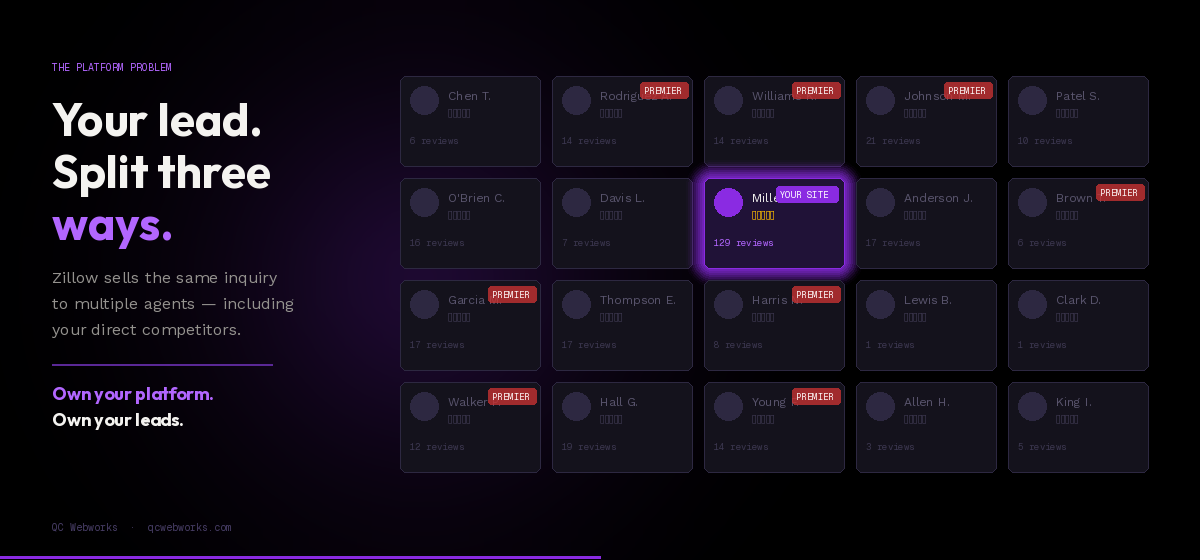
Zillow’s business model is built on selling your leads back to you. When a buyer clicks “Contact Agent” on a Zillow listing, that inquiry does not go exclusively to you. Zillow’s Premier Agent program sells that lead to multiple agents simultaneously — often three, sometimes more. You are competing for a customer who was already looking at your listing.
Realtor.com does something similar. Your brokerage website, if you have a page there at all, is one of hundreds or thousands of agent profiles the firm controls. If you leave the brokerage, the page goes with them — or disappears entirely. Your transaction history, your testimonials, your content: gone.
The agents who recognized this years ago did something different. They built their own platform. And in 2026, the gap between the agents who own their digital presence and those who rent space on someone else’s is becoming impossible to ignore.
A real estate agent’s website is not a brochure. It is the hub of a referral, lead capture, and trust-building system that runs around the clock — without splitting the lead with anyone.
What an Agent-Owned Website Actually Does
There is a meaningful difference between a website that exists and a website that works. Most agent websites that do exist fall into the “exists” category — a headshot, a bio, some listings pulled from IDX, and a contact form. The problem is that a website like that does not give a visitor any reason to reach out, stay, or come back.
A high-performing real estate website does several specific things:
It captures intent before the visitor leaves. Most first-time visitors to any website do not fill out a contact form. They are researching. A smart site gives them a reason to exchange their email address — a home valuation estimate, a neighborhood market report, a downloadable buyer’s guide — so you can follow up even after they click away.
It establishes authority through content. Buyers and sellers in the Quad Cities are not just looking for an agent. They are looking for someone who knows this market specifically. A website that speaks intelligently about the difference between Rock Island and Bettendorf price trends, or what is happening in the Moline new construction market, signals that you are not just an agent — you are a local expert.
It converts trust into action. Reviews and testimonials on your own website carry different weight than a review buried on your Zillow profile. When someone reads a client success story on a site you control — with your branding, your voice, your market knowledge surrounding it — the social proof lands harder. There is no competing agent two scrolls away.
It owns the relationship with the seller. Homeowners ready to list want to know their property will be presented well. A polished, fast-loading website signals that you take presentation seriously — and a seller who sees you can build a beautiful digital experience will trust you to market their home that way too.
Speed and First Impressions Are Doing More Work Than You Think
A real estate purchase is one of the largest financial decisions most people will ever make. The trust threshold is correspondingly high. And in 2026, that trust evaluation starts online — usually before a buyer or seller has spoken to a single human being.
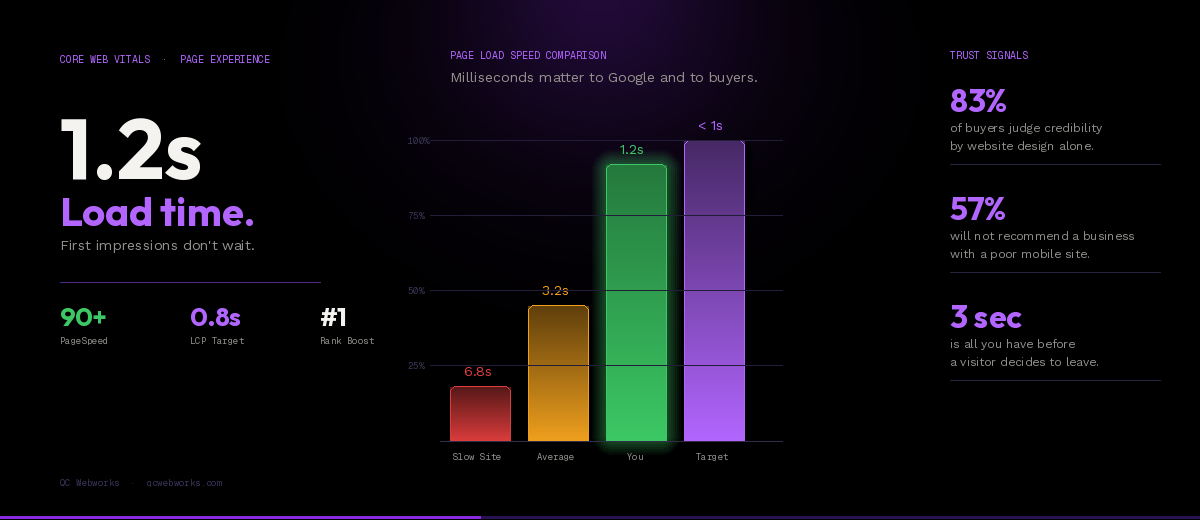
Research from the National Association of Realtors has consistently shown that the overwhelming majority of buyers use online resources during their home search. More than half of all home searches now start on a mobile device. This means your website is not a secondary channel — it is the first handshake.
A slow website, an outdated design, or a site that breaks on mobile is not just an inconvenience. It is a message. It tells a prospective client that you do not invest in your own presentation — and if you do not invest in your presentation, why would they trust you to handle theirs?
Google’s Core Web Vitals algorithm now factors load speed and user experience directly into search rankings. A fast, well-built site ranks higher and converts better. These are not two separate benefits — they compound each other.
The IDX Question: Listings Matter, But They Are Not Enough
Most agents who do invest in a personal website focus heavily on IDX integration — the live MLS feed that shows active listings. That matters. Buyers do want to search listings on your site. But IDX alone is not a differentiator, because every agent who has a website has IDX. If the only reason someone lands on your site is to search for listings, you have not given them a reason to contact you instead of the next agent with the same feed.
The agents winning with their websites treat IDX as one tool inside a larger system — not the system itself. They surround their listings with content that answers the questions buyers actually have: what is the school district like, what are closing costs in Iowa vs. Illinois, how long does the average home sit on the market in this zip code right now. That content drives organic search traffic. It positions the agent as the guide, not just the gatekeeper to the MLS.
What to Look For When Choosing Someone to Build Your Site
Not every web design agency understands what a real estate website needs to do. Here are the things that matter and the questions worth asking before you hand over the project:
Do they build custom, or do they use generic templates? Template-based real estate website platforms — and there are dozens of them — are fast to launch and easy to ignore. They look like every other agent’s site because they are built on the same framework. Custom design is not just about aesthetics; it is about ensuring your site communicates your specific brand, market, and value proposition.
Do they understand local SEO? Ranking for “real estate agent Moline IL” or “homes for sale in Bettendorf Iowa” requires deliberate on-page optimization, proper metadata, Google Business Profile integration, and content that signals local authority. A web designer who does not ask about your geographic targets is not thinking about your business — they are thinking about getting the site done.
Will you actually own the site? Some platforms that market to real estate agents retain ownership of the underlying site. If you stop paying, the site disappears. Insist on owning the domain, the hosting account, and the content outright. Your website should be an asset you accumulate, not a subscription you depend on.
Can they handle ongoing maintenance and updates? A website is not a one-time project. Market conditions change. Listings come and go. Content needs updating. Having a team that can make quick changes, ensure the site stays secure and current, and help you add new pages over time is worth more than a cheaper build that goes stale in six months.
The Quad Cities Market Has Room for Agents Who Get This Right
The Quad Cities is a relationship-driven market. People refer agents they trust. But referrals have a shelf life — when someone moves to the area from out of state, or a first-time buyer starts their search on Google at 10pm on a Tuesday, they are not asking a neighbor for a recommendation. They are searching. And the agents who show up — with a fast site, a clear value proposition, and content that answers their questions — are the ones who get the call.
The good news is that most agents in this market are not doing this well. The threshold for standing out is lower than it is in a major metro. A thoughtfully built, well-maintained website with some focused content is enough to distinguish you from the vast majority of the competition.
That window will not stay open forever. The agents who invest now will hold search positions, accumulate reviews, and build content libraries that compound over time. The ones who wait will be competing against that head start.
Owning your digital presence as a real estate agent is not a luxury anymore. It is a business decision with a clear and measurable return. Every lead your website captures is a lead you did not split with Zillow, did not lose to a slow follow-up, and did not hand to a competitor because your profile was buried on page three.
The agents building momentum in this market right now are doing it intentionally. That is replicable — if you start.
Ready to Own Your Online Presence?
We design custom websites for real estate professionals in the Quad Cities — built for speed, local SEO, and lead conversion. No templates. No locked-in platforms. You own it outright.
See Our Web Design ServicesSources
- National Association of Realtors — Profile of Home Buyers and Sellers (2025)
- Zillow — Premier Agent Program Overview and Lead Distribution Model
- Google — Core Web Vitals and Page Experience Documentation
- BrightLocal — Local Consumer Review Survey 2026