
Website and SEO audit
$349
Not sure where to start
Find out what is actually wrong before buying a channel.
- Ranked fix list in 5 business days
- 30-minute walkthrough
- Credited toward any project
A great site does nothing if nobody sees it. We start from the number you care about, whether that is leads, calls or booked jobs, and work backward to the one or two channels that move it.
CHANNEL STRATEGY
An emergency plumber, a dental practice and a B2B supplier should not run the same marketing mix. Search demand, sales cycle, geography, deal size, proof and budget decide which channels deserve attention first.
A focused plan may use only one or two of these. Adding everything at once makes it harder to learn what is actually working.
WHAT WE RUN
Each has its own page, its own scope and its own price. None of them requires the others.
RUN, LEARN, ADJUST
Reports separate activity from business progress. Traffic, rankings and open rates diagnose a channel. Qualified conversations decide what happens next.
INBOUND AND OUTBOUND
Inbound marketing pulls buyers to you. A BDR agent goes out and starts conversations. Run them together and you are not waiting on any single channel to hit the number.
How fast each channel moves
Illustrative example
How long the result lasts
Illustrative example
The fast channels buy time for the durable ones. That is usually the whole plan.
INVESTMENT & TIMING
$349
Not sure where to start
Find out what is actually wrong before buying a channel.
$450to $750/month
Most common
Local SEO, content, paid search or email, with tracking underneath it.
Custom
Bundle
Website, marketing and BDR agents as one connected system.
Paid-media fees exclude ad spend. Platform costs are itemized in your proposal. No responsible plan guarantees a specific result by a fixed date.
No. The first plan should use the smallest channel mix likely to reach the goal and produce useful evidence.
No. We work month to month and earn the renewal with results. If a channel is not paying off, we tell you and change it.
Usually. The site is reviewed as part of the conversion path. If a focused page or technical fix is enough, a full rebuild is not necessary.
It depends on the channel, competition, offer, budget, starting point and sales cycle. Paid campaigns can generate data quickly; organic search usually takes longer to compound. No responsible plan guarantees a specific result by a fixed date.
Agree on a simple definition of a qualified lead, keep source tracking intact, and share sales outcomes. Marketing data is much more useful when it can be connected to what happened after the form or call.
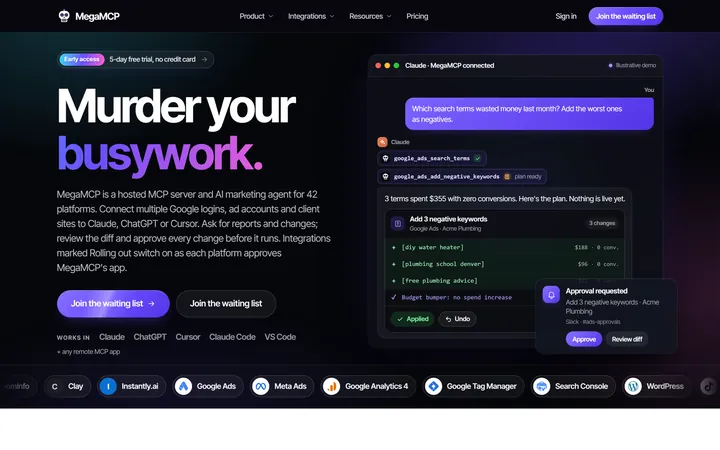
A brand with a voice, a live product demo, flat pricing and a page for every integration.

A service finder, an interactive handoff demo and a guided first step into the contact form.
Real projects, with the context and decisions explained. Explore all our work.