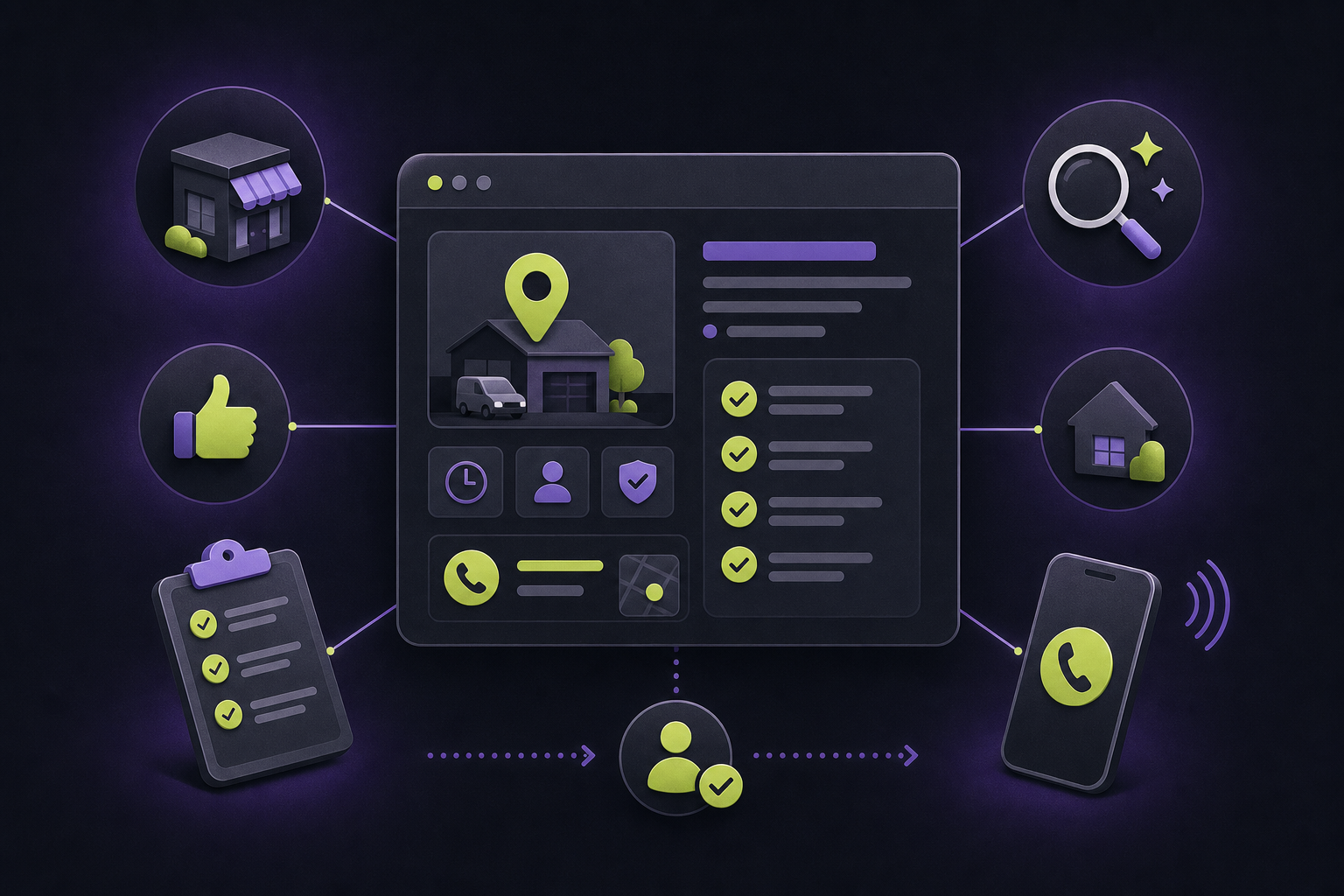
A local service page should make it easy for a nearby customer to decide whether you can solve their problem and what to do next. The strongest pages explain one real service, who it is for, where it is available, what the process looks like, and how to get in touch–without trying to manufacture a separate page for every keyword variation.
Why a service page is more than a list of keywords
Someone searching for a service is often close to making a decision. They are not looking for a paragraph that repeats a city name; they need enough evidence to decide whether to call, request a quote, or keep comparing options. A useful page reduces that uncertainty.
Google’s Search Essentials advises site owners to use the words people use when looking for content in prominent, descriptive places such as the title and heading. Its broader guidance also emphasizes helpful, reliable, people-first content. In practice, that means describing the service clearly and then earning attention with details a prospective customer can act on.
The local service-page decision path
State the service and the situation that prompts a customer to look for it.
Show who the service is for, what is included, and where it is available.
Answer practical questions about timing, process, qualifications, and scope.
Offer one clear, visible way to request the next appropriate step.
Equivalent text: a good page moves from the customer’s problem to service fit, then to the practical information that supports a confident inquiry.
What every useful local service page should include
- A descriptive page title and main heading that name the actual service.
- An opening that answers what the service is and who it helps before broad background information.
- Specific scope: common jobs, deliverables, constraints, or service boundaries.
- Accurate service-area context, but only for places you genuinely serve.
- Visible business contact details and a clear next action.
- Helpful internal links to related services, proof, maintenance information, or contact options.
- FAQs based on the questions a customer needs answered to decide.
Write for a real local decision, not a city-name template
Start by defining the customer’s job to be done. For a home-service company, the query may come from an urgent repair, a planned replacement, or a request for an estimate. For a professional service, it may come from a change in circumstances, a deadline, or uncertainty about available options. Those situations deserve different explanations even when the core service category is similar.
Then add location information where it changes the customer’s decision: the cities or communities served, travel limits, appointment availability, local regulations that affect the work, or whether on-site visits are available. Do not create near-identical pages for every neighborhood or city unless each page has a distinct, useful reason to exist. Google’s current AI-search guidance specifically warns against producing separate pages for every possible query variation simply to manipulate rankings or generative responses.
A practical page structure
Open with the service and outcome
Use the first paragraph to say what you do, who you help, and what a customer can expect. For example, a page for custom website design could explain that it is for established Quad Cities businesses that need a site built around their services, lead path, and content rather than a generic template. Avoid leading with agency history or a vague claim such as “we are the best.”
Show the work behind the offer
Give visitors a concrete picture of the engagement. Describe discovery, content planning, design, development, launch, maintenance, or another honest process that applies to the service. Add decision criteria: when the service is a good fit, when a smaller option may be enough, and what information makes an estimate more useful.
Connect related pages with descriptive links
Internal links help visitors continue their research when they identify the next question. A web-design service page might link to QC Webworks’ services overview, its approach to accurate local-business information, and the contact page for a project conversation. The link text should tell people what they will find, rather than saying only “click here.”
Give a single, low-friction next step
A service page does not need a dozen competing calls to action. Ask for the next reasonable commitment: request a quote, schedule a consultation, share a project brief, or call about an urgent need. Set expectations honestly about what happens after the form or call. This is where page structure and follow-up operations meet; a page that earns an inquiry should also make it easy for the business to respond.
How to tell whether a page deserves its own URL
Create a separate page when the offer, audience, process, proof, or local availability meaningfully changes. A true distinction might be residential versus commercial work, emergency service versus planned installation, a separate physical location, or a specialized service with its own questions and examples.
Keep information together when the only change would be swapping city names, synonyms, or tiny wording variations. Consolidating closely related content usually gives customers one stronger resource and gives the business one page to maintain accurately. This approach also supports the clear, trustworthy information that answer engines need to summarize a business correctly.
A five-minute quality check before publishing a service page
- Can a first-time visitor say what the service is after reading the opening?
- Does the page explain a real difference between this offer and related offers?
- Are every location and service claim accurate and visible to a customer?
- Would the FAQs help a prospect choose, prepare, or contact you?
- Does each link describe its destination and does the next action match the visitor’s stage?
- Could a reader get the essential answer without being forced to watch a video or interpret an image?
When a service page needs a rebuild
Consider revising when the page leads with generic marketing language, buries contact options, has no visible service boundaries, repeats city names without useful context, or sends every visitor to the same vague form. Also revisit it after a service change, new market, rebrand, website migration, or shift in how leads are handled.
QC Webworks helps established Quad Cities businesses turn service knowledge into custom sites, useful content, and dependable lead paths. If your current pages describe what you do but do not help customers decide, start a conversation with QC Webworks about a practical website and content review.
Frequently asked questions
How long should a local service page be?
Use the length needed to answer the decision questions a customer has. Google does not prescribe a preferred word count. A straightforward service may need a concise page; a complex or high-consideration service may need more process, scope, and FAQ detail.
Should I make one page for every city I serve?
Only when each page has a genuinely distinct purpose and helpful local information. Swapping place names into nearly identical copy can create a weak experience and a maintenance burden. Keep a clear service-area explanation on the relevant service page when that is more honest and useful.
Do service pages need FAQs for SEO?
FAQs are useful when they resolve real pre-contact questions. They are not a shortcut to rankings or a reason to add filler. Use questions about process, eligibility, timing, scope, preparation, or what happens next.
What is the best call to action for a service page?
The best next step matches the visitor’s readiness and the business process. A quote request can fit a defined service, while a consultation may suit a complex project. Make the action clear and explain what the visitor can expect after taking it.
Can AI search tools understand a local service page?
They are more likely to understand pages that state real services, locations, and decision details clearly in accessible text. Do not build separate pages merely to target every possible AI query. Focus on accurate, people-first information and a sound site experience.