A couple in Bettendorf starts looking for a home. They search “homes for sale Quad Cities” and get a wall of portals: Zillow, Realtor.com, Homes.com, brokerage sites. Your name may appear somewhere in that mix, surrounded by every other agent in the market and ad slots you did not buy. Where in that experience do they choose you?
Most agents have quietly accepted this. They have a Zillow profile, a Realtor.com page, a brokerage subdomain the corporate office controls, and a Facebook page they update when they remember. Being present on those platforms is not the same as having your own online presence. It is closer to renting a booth at someone else’s trade show.
Why a brokerage profile is not a website
Portals are built to sell agent leads. On Zillow, a buyer who asks about a home is often connected with an agent who pays Zillow for leads in that area, which may not be the listing agent. How those inquiries are routed varies by market and has changed over the years, but the principle holds: the platform, not you, decides who gets the conversation.
Your brokerage page has a different problem. It is one of many agent profiles the firm controls. If you change brokerages, the page goes with them or disappears, along with the testimonials, sold history and any content you added.
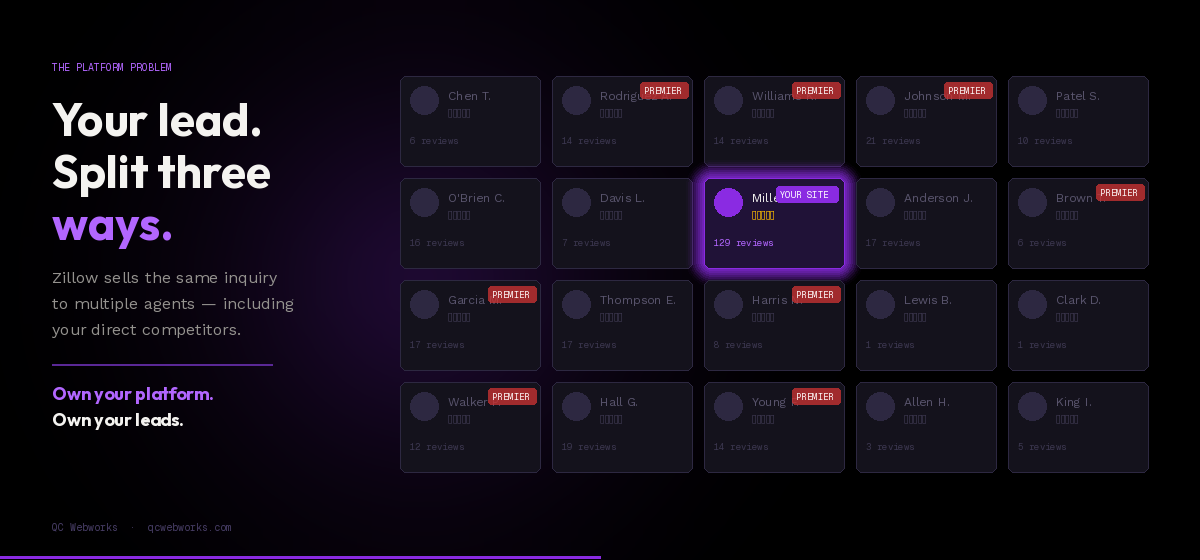
A real estate website is not a brochure. It is the one place online where you do not share the lead with anyone.
Portal profile vs. brokerage page vs. your own site
Portal profile
Zillow, Realtor.com, Homes.com
- Lots of buyer traffic
- Other agents shown near your name
- Platform controls lead routing
- Reviews stay on the platform
Brokerage page
Included with your brokerage
- Free and quick
- Looks like every other agent’s page
- Limited control over content and SEO
- Goes away if you switch firms
Your own website
Your domain, your content
- No competing agents on the page
- You choose what to publish and how to capture leads
- Builds search visibility over years
- Moves with you between brokerages
You do not have to abandon the portals. Keep the profiles, collect reviews there, and use your own site as the place every other channel points to.
Realtor website design: what an agent-owned site should do
There is a difference between a site that exists and a site that works. Many agent sites are a headshot, a bio, an IDX feed and a contact form. That gives visitors no reason to reach out, stay or come back. A site that works does four jobs.
It captures interest before the visitor leaves
Most first-time visitors are researching, not ready to call. Give them a reason to share an email address: a home value estimate, a neighborhood market report, a buyer’s guide for first-timers. Then you can follow up after they click away. Keep the form short; these contact form best practices apply to lead magnets too.
It shows you know this market
Buyers and sellers want someone who knows the Quad Cities specifically. Pages that explain the difference between neighborhoods, how long homes are sitting in a zip code right now, or what a move from Moline to Bettendorf changes for taxes and schools signal local expertise in a way a portal profile cannot.
It turns trust into action
Reviews and client stories on a site you control land differently from a review buried on a portal, because there is no competing agent two scrolls away. Pair them with real photos of homes you sold and the people you helped (with permission). A website photo shot list helps you collect the right images.
It wins listings
Sellers want to know their home will be presented well. A fast, well-designed site with strong listing pages is a preview of how you will market their property.
The IDX question: listings matter, but they are not enough
IDX (Internet Data Exchange) is the feed that lets you display MLS listings on your own site. You generally need MLS membership, your broker’s participation, and an IDX vendor subscription, and you have to follow the MLS’s display rules. Buyers do want to search listings on your site, so it belongs there.
But IDX alone does not set you apart, because every agent with a website can show the same feed. It also depends how it is set up: many IDX tools show listings in a frame or on the vendor’s own subdomain, which does little for your site’s search visibility. Ask your designer how listings will be displayed before you choose a vendor.
The agents who do well treat IDX as one tool inside a bigger site. They surround listings with answers to the questions buyers actually ask. In this market that includes something no national template covers: Iowa and Illinois handle closings differently. Iowa uses its state-run Iowa Title Guaranty program instead of private title insurance, and buyers moving across the river often do not know that. A clear page explaining what changes when you buy on the other side of the river is exactly the kind of content that earns search traffic and trust. Our guide to ranking in both Iowa and Illinois covers how to structure pages for both states.
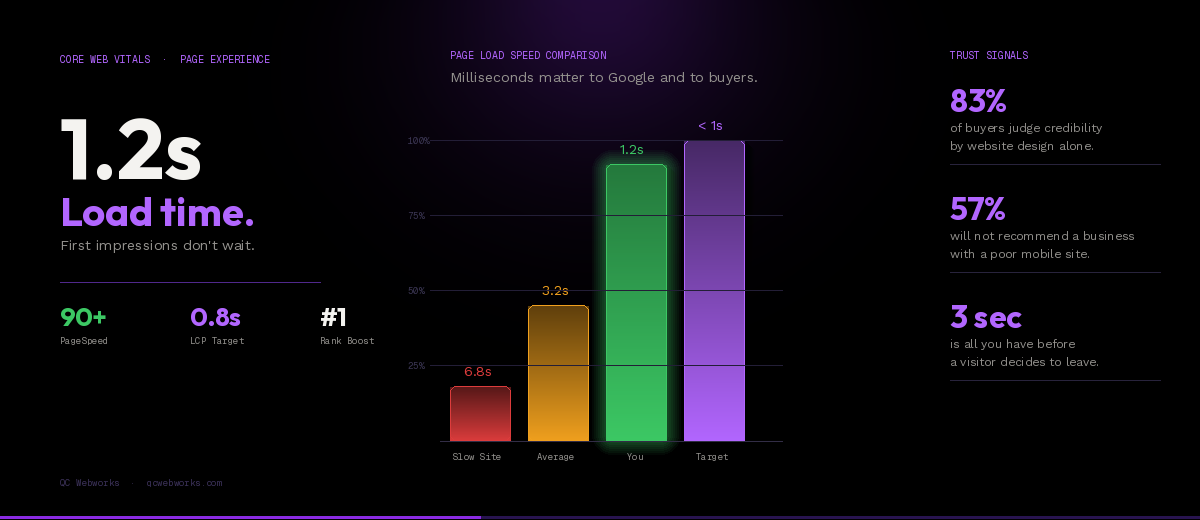
Speed and first impressions do more work than you think
Buying a home is one of the largest financial decisions most people make, so the trust bar is high, and the first test now happens online. The National Association of Realtors’ annual Profile of Home Buyers and Sellers has consistently found that most buyers use online tools during their search, much of it on a phone.
A slow site, a dated design or a page that breaks on mobile sends a message: if you do not invest in your own presentation, why would a seller trust you with theirs? Google also uses Core Web Vitals as part of how it evaluates page experience. Relevance still matters most for rankings, but a fast, stable site helps both your search visibility and the share of visitors who reach out.
Check the rules before launch. Iowa and Illinois both regulate how licensees advertise, including showing your brokerage name, and your MLS sets rules for how IDX listings are displayed and credited. Review your site with your managing broker before it goes live.
What to ask before hiring someone to build your site
- Custom or template? Template real estate platforms launch fast but look like every other agent’s site. Ask to see sites they built for agents and whether any two look the same.
- Do they ask about your farm areas? Ranking for “homes for sale in Bettendorf” or “realtor in Moline” takes deliberate pages, metadata and Google Business Profile work. A designer who never asks where you sell is not thinking about leads.
- Will you own it? Some agent platforms keep the site if you stop paying. Insist on owning the domain, hosting account and content. Here is how to check who actually owns a pay-monthly website.
- How will IDX be integrated? Ask whether listing pages live on your domain and whether they can be indexed by search engines.
- Who handles updates? Markets change and content goes stale. Know who updates pages, keeps plugins current and adds new neighborhood pages over time.
What a realtor website costs
| Option | Upfront | Ongoing | Who owns it |
|---|---|---|---|
| Brokerage profile page | Included | Included | The brokerage |
| Real estate template platform | Low or none | Monthly subscription for as long as the site runs | Varies; often the platform |
| Custom site (QC Webworks Starter, 3 to 5 pages) | From $1,499 | Hosting, plus your IDX vendor’s fee | You |
| Custom site (QC Webworks Growth, 6 to 15 pages) | From $2,999 | Hosting, plus your IDX vendor’s fee | You |
IDX vendor pricing varies by provider and MLS, so get a quote for your market before comparing totals.
The Quad Cities market rewards agents who do this well
The Quad Cities is a relationship market, and referrals still matter. But when someone relocates from out of state, or a first-time buyer starts looking at 10 p.m. on a Tuesday, they are not asking a neighbor. They are searching. The agents who show up with a fast site, a clear point of view and content that answers their questions are the ones who get the call.
The bar here is lower than in a major metro. A well-built, maintained site with focused local content is enough to stand apart from most agents in this market, and the pages, reviews and search visibility you build keep working for years.
Frequently asked questions
What is an IDX website?
An IDX website is a real estate site that displays live MLS listings through an Internet Data Exchange feed, so visitors can search homes without leaving your site. It requires MLS membership, broker participation and an IDX provider, and it must follow your MLS’s display rules.
Do real estate agents need their own website if they have a Zillow profile?
Yes, if you want leads you do not share. A portal profile is useful for visibility and reviews, but the platform controls who gets the inquiry. Your own site is the one place a buyer or seller can contact you without being shown other agents.
How much does a realtor website cost?
Template platforms charge a monthly fee with little upfront cost. A custom site from QC Webworks starts at $1,499 for 3 to 5 pages or $2,999 for 6 to 15 pages, plus hosting and your IDX provider’s fee. The bigger long-term question is who owns the site when you stop paying.
Can I take my website with me if I change brokerages?
If you own the domain, hosting and content, yes. You will need to update brokerage details and possibly your IDX setup to meet the new firm’s and MLS’s rules. A brokerage-provided page usually stays behind.
How do realtor websites generate leads?
Through local search traffic to area and neighborhood pages, lead offers such as home valuations and market reports, listing search that asks for an email to save favorites, and reviews that convince visitors to call. The website also gives every other channel (social, print, referrals) a place to send people.
Start by listing the three areas you most want to sell in and checking whether you have a page for each one. If you want a site built around that, see how we approach real estate websites or start with our web design process.
Sources
- National Association of Realtors: Profile of Home Buyers and Sellers (2025)
- Zillow: Premier Agent program overview and lead distribution model
- Google Search Central: Understanding Core Web Vitals and Google search results
- BrightLocal: Local Consumer Review Survey 2026
- Iowa Finance Authority: Iowa Title Guaranty program